MailThreatZero is an on-premise-controlled, multi-layer email security gateway. It evaluates every message through independent security layers and combines their results into a single weighted threat score. Traditional scanners run first (Phase 1); optional AI runs second (Phase 2) only when it can still change the outcome — keeping AI cost down while maintaining full coverage. You keep your data, your mail server, and your AI keys.
Why MailThreatZero
Serious filtering without the complexity or per-user pricing games.
No per-user pricing
Pay per domain — a domain with 5 users costs the same as one with 500. Scale without watching a billing counter climb.
Transparent AI costs
You supply the API key and pay OpenAI or Anthropic directly at their listed rates. We don't mark it up.
Works with any mail server
SMTP relay setup compatible with Exchange, Office 365, Google Workspace, Postfix, Dovecot — anything that speaks SMTP.
Full filter visibility
See exactly which filters fired, what scored, and why a message was quarantined — per message, not just "blocked by spam filter."
Fewer false positives
Authentication-aware scoring recognizes SPF/DKIM/DMARC-verified senders and stops penalizing normal newsletter and billing-mail patterns.
On-premise control
Your email never has to route through a third-party cloud. Full data sovereignty and no vendor lock-in.
Watch the walkthrough
A quick tour of the admin interface (sensitive recipient/IP data blurred).
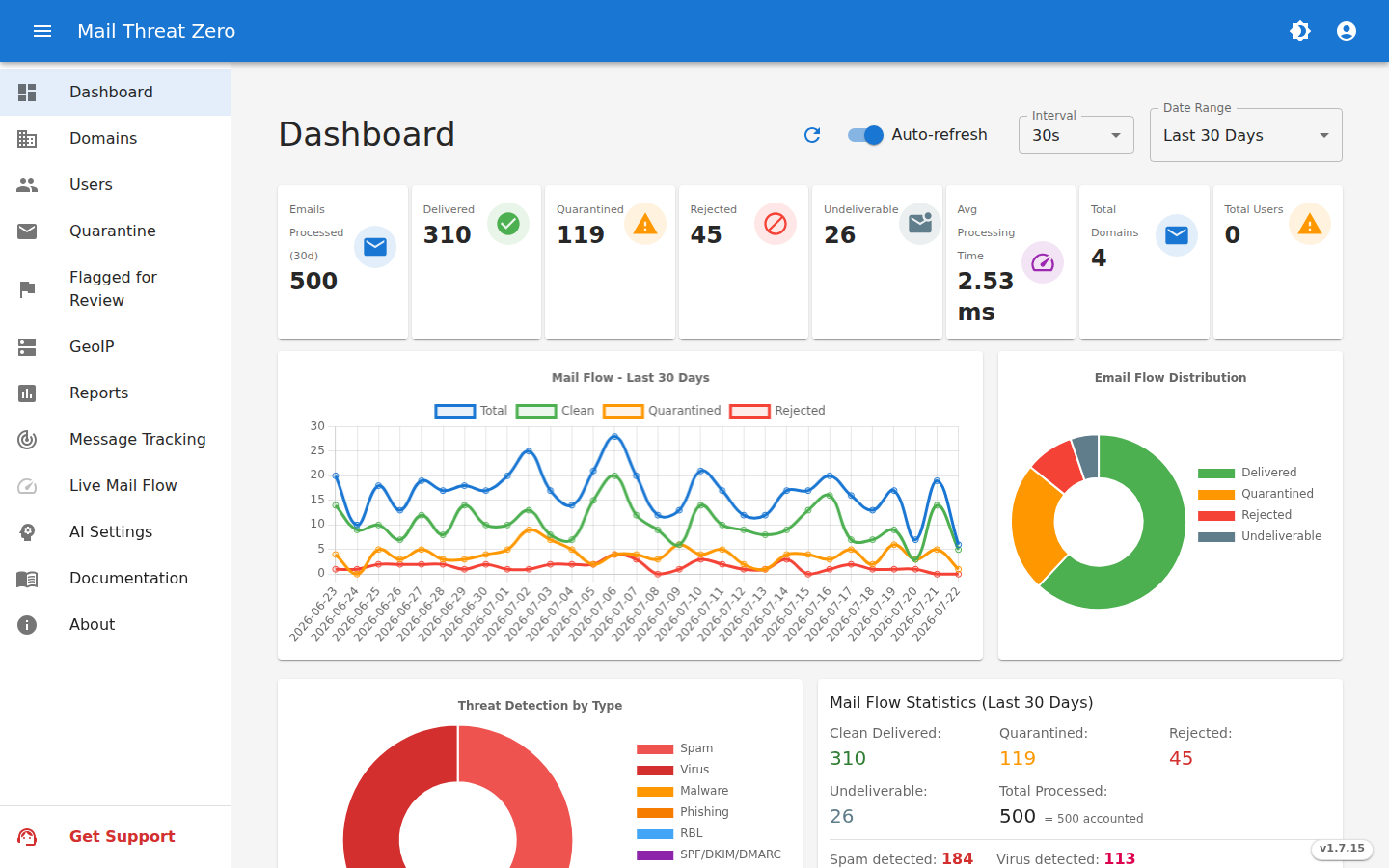
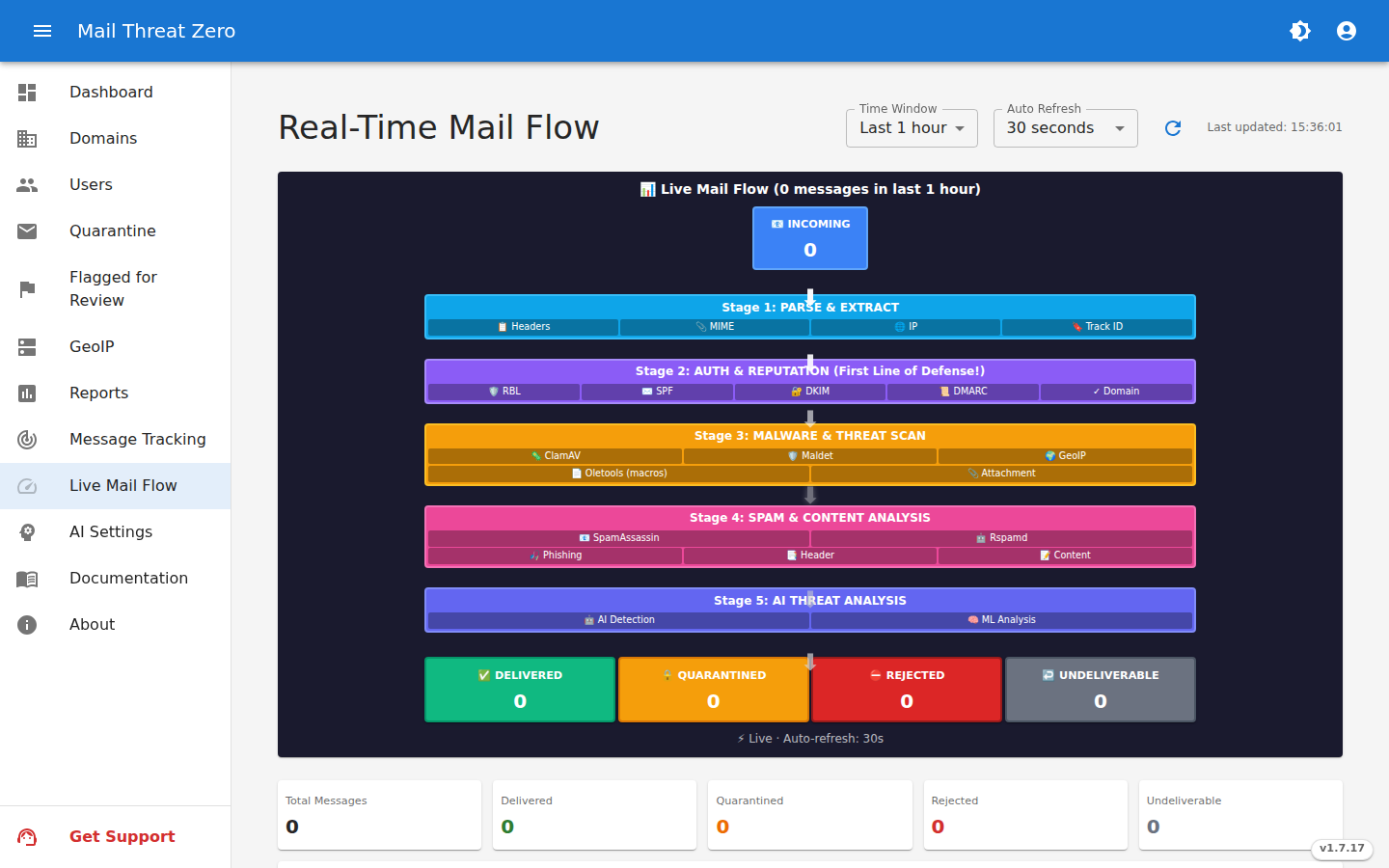
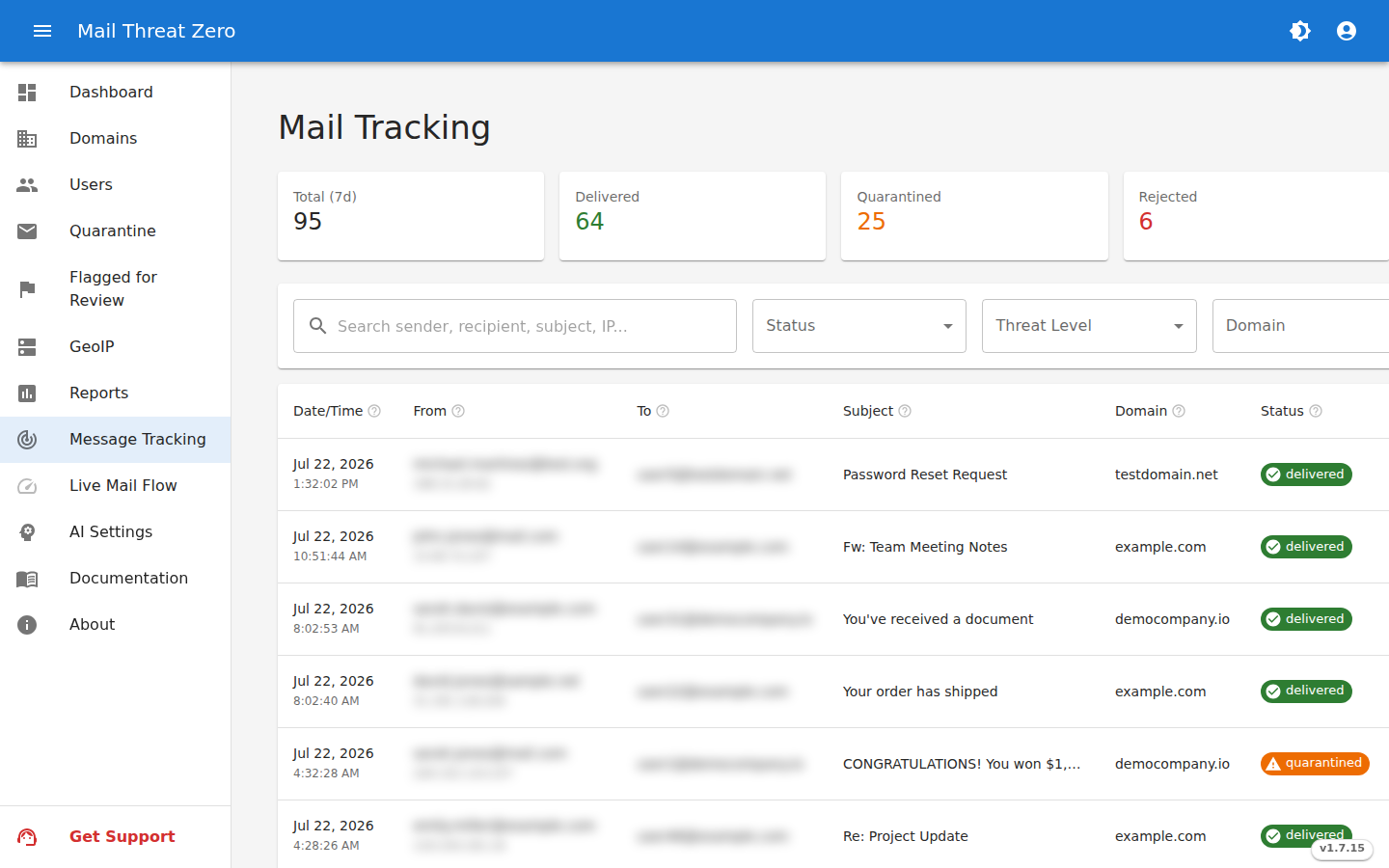
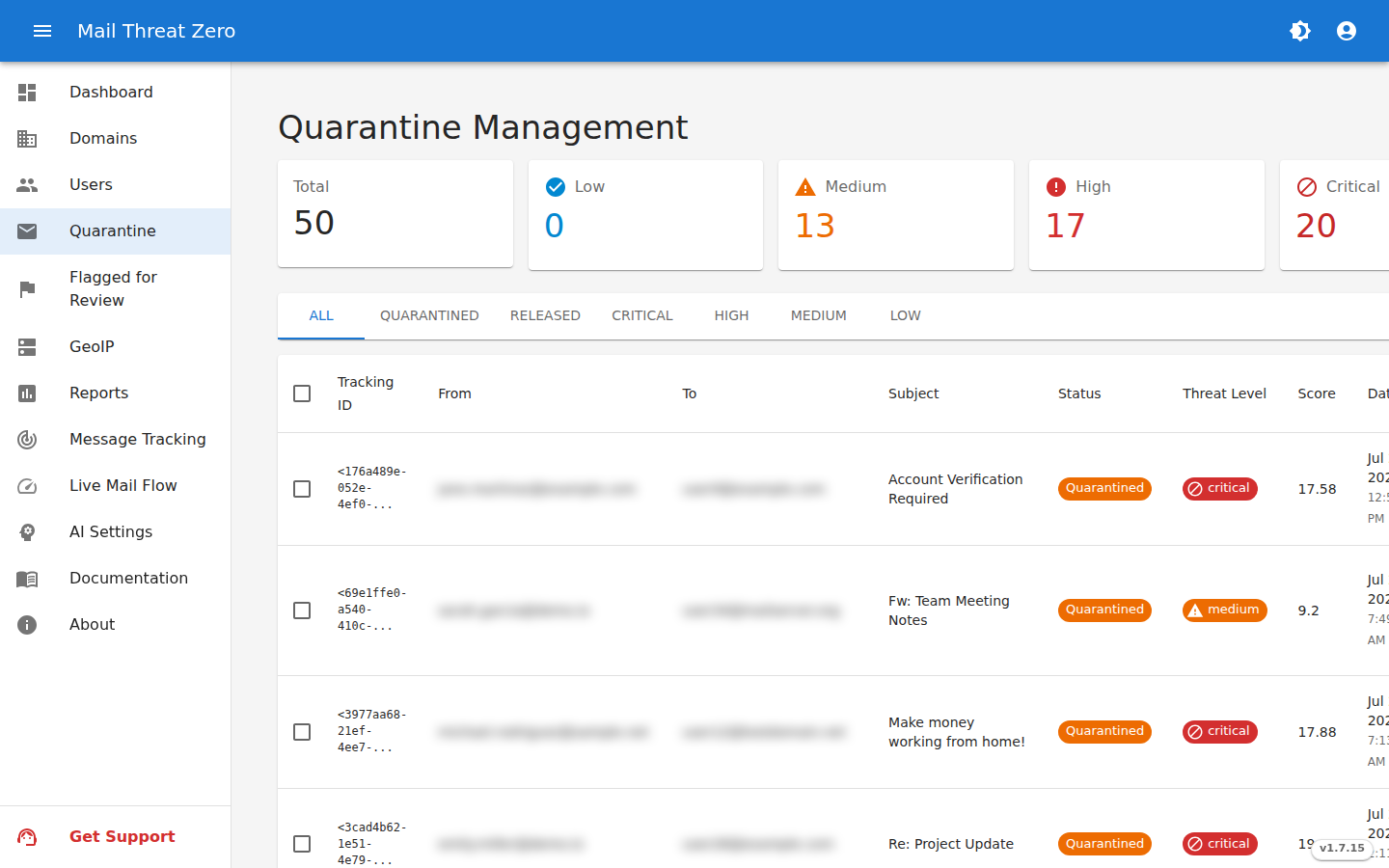
See it in action
The React admin interface — live mail flow, dashboards, and per-message filter breakdown.
Phase 1 — Traditional Scanning (always runs, in parallel)
Deterministic engines run concurrently on every message. A virus or malware hit quarantines immediately.
RBL / DNSBL + IP Reputation
Six DNS blocklist lookups (Spamhaus, SpamCop, Barracuda, SORBS, PSBL, and more) plus IP reputation scoring, reverse-DNS and ASN analysis. Connections from known-bad hosts are penalized before content is parsed.
Score weight: RBL ×3 per hit · reputation ×2GeoIP & ASN Filtering
MaxMind GeoLite2 locates the sender by country, city, and ASN. Per-domain rules can block or quarantine specific countries or networks via a visual world-map manager.
Score weight: ×1 (configurable per domain)SPF · DKIM · DMARC
All three are validated and enforced, not just logged. SPF authorizes the sending IP, DKIM verifies the cryptographic signature, and DMARC checks alignment. Results also drive authentication-aware scoring across the content filters.
Score weight: SPF fail ×2 · DKIM fail ×2 · DMARC fail ×3ClamAV + Maldet
ClamAV with official and unofficial (Sanesecurity/SecuriteInfo) signatures, updated daily, plus Linux Malware Detect for webshells and server-side threats. A detection is critical and quarantines instantly.
Score weight: ×100 (critical — instant quarantine)Oletools + Attachment Filter
Oletools/olefy inspects Office attachments for VBA macros, auto-execution triggers, and obfuscated content. The attachment filter blocks dangerous extensions, double extensions, archive bombs, and executable content in documents.
Score weight: varies by threat level (10–100)SpamAssassin + Rspamd
SpamAssassin (550+ rules, Bayesian filtering) plus Rspamd with neural networks, statistical analysis, fuzzy hashing, and Pyzor/Razor2 collaborative fingerprinting. URL reputation is checked on every link.
Score weight: spam score ×5Phishing · Header · Content Filters
Deterministic filters catch lookalike/homograph domains, URL display-vs-link mismatch, display-name spoofing, spoofed/anomalous headers and Message-ID checks, suspicious keywords, and HTML obfuscation (hidden text, tiny fonts).
Score weight: calibrated to the 5/10/20 thresholdsAuthentication-Aware Scoring
How we keep legitimate newsletters and billing mail out of quarantine.
When a sender passes SPF/DKIM/DMARC (or is explicitly whitelisted), the phishing, header, and content filters record but exclude from the score the signals that are unreliable for a domain-verified sender — brand-name impersonation, urgent-tone language, normal ESP routing (Reply-To / Return-Path / Message-ID mismatches), and soft spam-tone heuristics (marketing keywords, ALL-CAPS, excessive punctuation). Hard signals always score regardless of authentication: homograph/typosquat domains, URL display/link mismatch, display-name spoofing, blocked keywords, blacklisted domains, and HTML obfuscation. The result is far fewer false positives on authenticated bulk mail, while real threats still get caught.
Phase 2 — AI Analysis (optional, cost-optimized)
AI runs only when the Phase 1 score is below the quarantine threshold — so credits aren't spent on mail already flagged.
Bring-Your-Own-Key LLM Scanner
Context-aware detection of business email compromise (BEC), executive impersonation, social engineering, and novel phishing that rules miss. You supply the API key and pay the provider directly — zero markup.
Models: Claude Haiku 4.5 · Sonnet 5 · Opus 4.8 · GPT-4o mini · GPT-4oSolo-AI Cap & Bypass Rules
A non-critical AI verdict can't quarantine mail on its own without corroboration from other scanners, preventing AI-only false positives. Whitelisted senders and AI-bypass rules skip AI entirely, and per-tenant credit usage is tracked.
Score weight: AI ×1 (AI already scales high-threat internally)Weighted Threat Scoring
All layers combine into one score, compared against per-domain thresholds.
Total = (ClamAV ×100) + (Maldet ×100) + (SpamAssassin ×5) + (Rspamd ×5)
      + (RBL ×3) + (Reputation ×2) + (SPF_fail ×2) + (DKIM_fail ×2)
      + (DMARC_fail ×3) + (GeoIP ×1) + (AI ×1) + content-filter scores
Action thresholds (configurable per domain):
- 0–5 (low): Clean — deliver
- 5–10 (medium): Deliver with warning header
- 10–20 (high): Quarantine for review (default quarantine threshold: 10)
- ≥ 20 (critical): Reject / bounce (default reject threshold: 20)
- Virus / malware: Immediate quarantine regardless of score
Additional Capabilities
Monitor-Mode Rollout
New filters can run log-only, recording the action they would have taken. Admins review the data, then promote to enforcing — and an enforcement watch flags any block where an advanced filter was decisive.
Honeypots / Spam Traps
Deceptive addresses feed live sender reputation and surface spam campaigns and address-harvesting activity.
Fuzzy & Regex Rule Engine
Per-domain fuzzy and regex rules encode organization-specific patterns with custom scores and actions — no server config edits.
Full-Journey Message Tracking
Every message records a complete per-scanner filter breakdown — each score, the weighted total, threat level, processing time, and final action — with live mail flow, message-path views, and flagged-message review.
Continuous Self-Monitoring
End-to-end pipeline health checks every few minutes, scheduled per-scanner self-tests, a scanner-status heartbeat, automated signature updates, and weekly summary reports.
Multi-Tenant & Compliance
Tenant isolation, role-based access control, two-factor authentication (TOTP), per-domain policy inheritance, quarantine release workflows, DNS validation tooling, SSL management, and audit logging.
Technology Stack
Backend
Python 3.12 · FastAPI · Uvicorn (ASGI) · SQLAlchemy · MySQL/MariaDB · Redis
Frontend
React 18 · Material-UI · Vite
Security Engines
ClamAV · Rspamd · SpamAssassin · Maldet · Oletools/olefy · GeoIP2
Infrastructure
Postfix MTA · JWT auth · 2FA/TOTP · automated cron updates